


DreamTrain
Mendi + Keith Obadike
view composer pageMendi + Keith Obadike
view composer page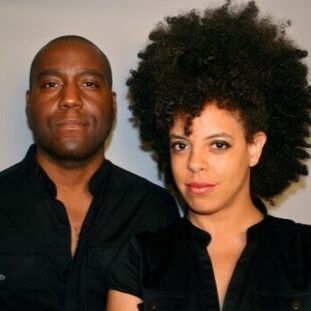
Duration:
Year Written:
Instrumentation:




More information about this work please fill out the form below.
Thank you! Your submission has been received!
Oops! Something went wrong while submitting the form.
DreamTrain is a work for installation with an orchestra and vocalists that invites participants to dream together. It builds on the work we began with our piece Four Electric Ghosts (2009) at The Kitchen. At the Sonic Festival, DreamTrain will be presented as a concert piece with a finite ending. In the installation version, DreamTrain would exist as a perpetual sound and video installation, framed by periods of live performance.
The songs in DreamTrain call listeners to a journey through the dreamscape, a place of communion with ancestors. The three vocalists in DreamTrain, whom we call singer-sayers, act as conductors or guides through the land of dreams. The piece pulls on both Igbo cosmology (from Nigeria) and African-American mythology.
The title DreamTrain points to the long history in African-American culture of trains as vehicles of spiritual transportation. The lyrics in the music of the past tell us that these spiritual vehicles deliver one to freedom, heaven, or spiritual revelation. Anyone familiar with gospel music and spirituals might know song titles like Gospel Train (Fisk Jubilee Singers) and This Train (Sister Rosetta Tharpe). Gospel music often has a mirror image in the world of the blues, where we find songs like I Hear My Train A Comin, When the Train Comes Along, and the work song Prettiest Train. And in the world of r&b and soul music we find transcendent trains in Curtis Mayfields People Get Ready, the O'jays Love Train. And of course there is the classic 70s music TV show Soul Train, whose title might also be a nod to Tadd Damerons (with John Coltrane) ballad Soultrane.
Lastly, in the world of visual art, the theme is explored in works like Rose Pipers painting Slow Down Freight Train (1947), John Biggers painting At The Railroad, (1988), and of course, Romare Beardens oeuvre, which includes Train Whistle Blues (1964), The Train (1975), and Moonlight Express (1978). Bearden ascribed this thematic recurrence (images of trains, but also moons, and even birds) in his work to an interest in journeying things. But where did this notion of spiritual transport come from? This themes relationship to the blues and gospel is quite apparent. But these spiritual journeying things are a much older tradition in African diasporic culture.
The Structure of DreamTrain
This notion of spiritual transportation is rooted in many African spiritual practices and beliefs including the Igbo system, Odinani. An Igbo creation myth begins DreamTrain in the 1st movement entitled Night Visions. In this myth, a sacred bird, the hornbill, travels over the expanse of a world covered with water while carrying her parents in her head. The hornbill in this creation story serves as a symbol of resurrection. In our piece, this story is reflected on as a memory and underscored with droning strings and pulsing percussion and woodwinds, which operate in a conversation with the vocalists. The piece shifts into a musical portal, a cycling harmonic progression, leading to the dreamtrain. The second movement in DreamTrain is a lullaby, Somniloquy. This piece is grounded in the rich sounds of the harp, and in it, the dreamer enters a mystical realm. In DreamTrain the land of dreams operates in a world parallel to our waking one. This piece is followed by an Interlude in which there is a lament, a reflection on a dream about a dying tree, a sacred Ofo tree, one typically used to make the staff of a leader or king. This is followed by the delicate Onwa Bridge, a torch song to the moon. One vocalist and vibraphone trace a silken melody over a gossamer-like piano and a warm bed of bass and percussion. Onwa means moon in Igbo, and this piece is a meditation on repeating lunar cycles. The last movement is Agwu Blues. In Agwu Blues the dreamer slowly awakens while still being pulled by a feeling received in the dream. The Igbo spirit Agwu is in some ways a parallel to the African-American concept of the holy ghost. It is a spirit that can sometimes act as a messenger from the spirit world. The piece tells its tale over a kind of double blues form and then builds to a full awakening.
We hope you enjoy the journey of DreamTrain.
Mendi + Keith Obadike
Recordings
No recordings found.
ACO PERFORMANCES
No information available
Recording
Journey
Neither man nor money validate my worth
Water Sings Fire - Excerpt
The Winter that United Us
Song of the Flaming Phoenix: Symphonic Poem for Sheng and Orchestra by Fang Man
Words for Departure for choir and orchestra by Hilary Purrington
No Thing Lives to Itself by Robin Holcomb
Red Dirt | Silver Rain (excerpt)
Bolero/Bachata from Tumbao
"Tumbao" Movement 1 "Salsa"
Yvette Janine Jackson Interview with Garrett McQueen
Mark Adamo + Jeffrey Zeigler in conversation with Garrett McQueen
Weathering by George Lewis
Lisa Bielawa: Sanctuary, Violin Concerto. mvt 3
Lisa Bielawa, Sanctuary, Violin Concerto mvt 2
Lisa Bielawa, Sanctuary, Violin Concerto mvt 1
Prophecy in Reverse by Paula Matthusen
Invisible Portals by Dai Wei
Tuxedo: Vasco 'de' Gama (2020) by Hannah Kendall
Restless Oceans by Anna Clyne
Viet Cuong + Victor Caccese of Sandbox Percussion in conversation with Garrett McQueen
Hello, Tomorrow! - Yvette Janine Jackson
Interview with Guillermo Klein
Chrystal E. Williams & Felipe Hostins in Conversation with Loki Karuna
Rei Hotoda in Conversation with Curtis Stewart
Kaki King and D. J. Sparr in Conversation with Curtis Stewart
Kaki King /D J Sparr - The Divided Mind from Modern Yesterdays
Kaki King - Puzzle Me You from Modern Yesterdays
Kaki King - Can’t Touch This or That or You or My Face from Modern Yesterdays
Kaki King - God Child from Modern Yesterdays
Materia Prima by Carlos Bandera
Floodplain by Ellen Reid
Fate Now Conquers by Carlos Simon
Her Land, Expanded by Tonia Ko
Right Now - John Glover/Kelley Rourke
Lowak Shoppala' (Clans) by Jerod Tate
Jazz Symphony by George Antheil
Spirituals for String Orchestra: 10. Homage To Ravel (An Arrangement of “Balm in Gilead”) by Steven R. Gerber
Frailejón by Samuel Torres
Demografía acústica: % / Acoustic Demography: % by Sofía Scheps
Dirty Ice by Madeline Merwin
Kaleidoscope by Eunsung Kim
Statements- a journal entry by Malachi Brown
After the Freeze by Anuj Bhutani
Hommage à Khāleqī by Daniel Sabzgabaei
Mimi's Song by Amy Nam
Gia Đình by Oswald Huỳnh
Rencontres by Brittany J Green
I forgot to say good morning today by Henry Dorn
Feast of Particles by Younje Cho
Fetters by Yuqin Strucky Yi
Increment by Will Stackpole
Restrung by Tommy Dougherty
Ashes and Embers by Yuting Tan
Wraith Weight by Elijah Smith
Bolghar by Adeliia Faizullina
Persephone by Patrick Holcomb
Tomas Peire Serrate: Rauxa
Lowak Shoppala' (Clans) by Jerod Tate
Right Now by John Glover & Kelley Rourke
Fate Now Conquers by Carlos Simon
Carlos Simon in Conversation with Garrett McQueen